Organic farming
Organic by history. Certified to international standards.
Cambodia's low historical agrichemical use is a structural advantage: land with a documented clean history can move to certified organic production substantially faster than converted conventional farmland. The pathway to international recognition is precise, and it is navigable.
The advantage
Why Cambodian land converts faster
Organic conversion rules are never waived. What Cambodia offers is land that already satisfies them.
Under EU rules, parcels that were natural or agricultural areas not treated with prohibited products may qualify for retroactive recognition of the conversion period, with satisfactory evidence covering at least three years (Regulation (EU) 2018/848, Article 10). Under the USDA National Organic Program, land qualifies where no prohibited substances have been applied for the 36 months preceding harvest (7 CFR 205.202).
Because many Cambodian smallholdings have long histories of minimal agrichemical use, producers who can document clean land history may qualify for retroactive recognition under EU rules or immediate eligibility under the USDA requirement. The commercial effect: a substantially shorter and cheaper path to certified organic supply than converting conventional farmland elsewhere in the region. Documentation is the hinge, and building that evidence base is part of Whitewater's advisory work.
The country's organic base is real but concentrated: cereals, mainly rice, cover roughly 92 percent of certified organic area, alongside pepper, cashews, fruits, herbs and vegetables. Cambodia's first EU-standard organic farm certification was achieved in Battambang province.
Certification landscape
From domestic certification to export recognition
Layer 1
Domestic: COrAA
The Cambodian Organic Agriculture Association certifies organic crop production for rice, vegetables, fruits, herbs and cereals. COrAA certification serves the domestic market and does not by itself confer international recognition.
Layer 2
Export: EU, USDA, JAS
Since 1 January 2025, organic exports to the EU must be certified as fully compliant with Regulation (EU) 2018/848 by an EU-recognised control body. USDA NOP and JAS each define organic separately; internationally accredited certifiers operating in Cambodia cover all three.
Layer 3
Premium: GI status
Kampot pepper, an EU Protected Geographical Indication since 2016 and the first GI registered under the Geneva Act of WIPO's Lisbon System, shows the ceiling: protection in more than 30 countries and premium grades at up to ten times non-GI prices.
Sources: COrAA; AGRINFO; EUR-Lex; eCFR; WIPO; KPPA pricing
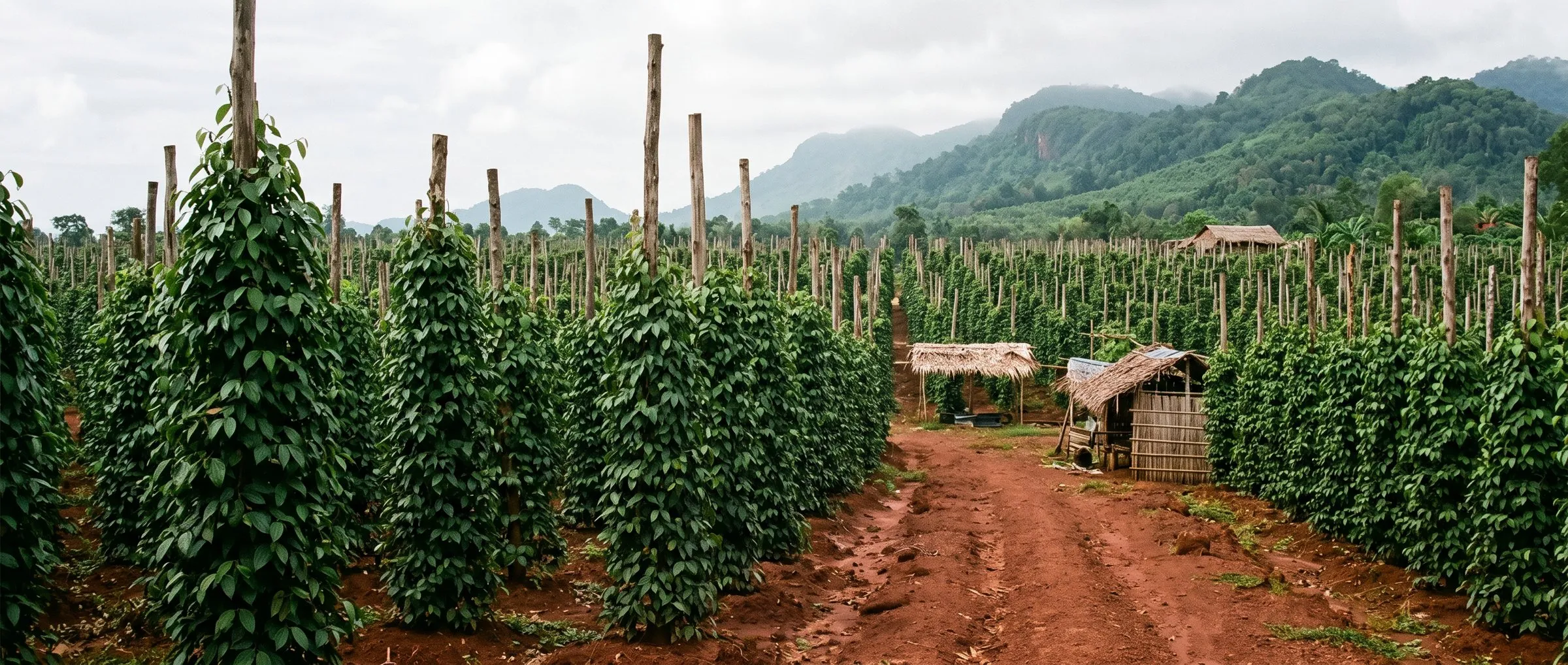
Kampot, coastal zone
Kampot pepper: an EU Protected Geographical Indication, protected in more than 30 countries.
Whitewater's role
Certification as an engineered outcome
Whitewater designs the certification pathway before the first crop is planted: land history documentation, certifier selection, protocol design for no-pesticide production at scale, and the audit calendar that keeps certification current once achieved. For manufacturers, the same discipline extends to GMP, ISO 22000 and HACCP alignment in processing facilities.
Planning an organic supply chain from Cambodia?
An exploratory consultation covers land history, certification routes and realistic timelines for your target markets.