Investment guide
The practical guide to agricultural investment in Cambodia
Business registration, tax holidays, land access and foreign ownership: what the rules actually say, attributed to the law and to institutional sources, not to promotional summaries.
Fiscal incentives
Qualified Investment Project status
The QIP regime under the 2021 Law on Investment is the fiscal foundation of most serious agricultural entries.
| Incentive | Detail |
|---|---|
| Corporate income tax holiday | 3 to 9 years by activity category, running from first income |
| Post-holiday relief | Six years of progressive relief: 25%, 50%, then 75% of tax due in two-year steps |
| Prepayment of tax | Exempt from the 1% prepayment during the holiday period |
| Customs duty | Duty-free import of capital goods: construction materials, construction and production equipment |
| Export-oriented QIPs | Production inputs also duty-free for Export QIPs and Supporting Industry QIPs |
| Eligible sectors | Agriculture, agro-industry and agro-processing expressly listed in the 2021 Law on Investment |
Sources: 2021 Law on Investment; PwC Tax Summaries Cambodia (reviewed 2026)
QIP applications are made to the Council for the Development of Cambodia, with certificates issued within 20 working days. Whitewater prepares and manages the application as part of entry structuring.
Ownership and land
What foreign investors can and cannot hold
Cambodia permits 100 percent foreign ownership of companies in most sectors, with no restrictions on the repatriation of capital or profits through authorised banks (US State Department, 2025 Investment Climate Statement). Sector exceptions requiring local participation include cigarette manufacturing, movie production, rice milling and gemstone processing.
Land is the structural exception. Foreign investors cannot own land; freehold title may be held only by Cambodian nationals or companies at least 51 percent Cambodian-owned. Entry is structured instead through registered long-term leases of 15 to 50 years, renewable for further terms of up to 50 years under the Civil Code, or through Cambodian-majority holding structures designed with local counsel.
Economic Land Concessions, historically the large-scale route to state land, are capped at 10,000 hectares and 50-year terms, and new grants have been under a government moratorium since 2012. Whitewater does not present ELCs as an available acquisition route; well-structured leasehold and cooperative supply arrangements are the workable paths, and in most cases the better ones.
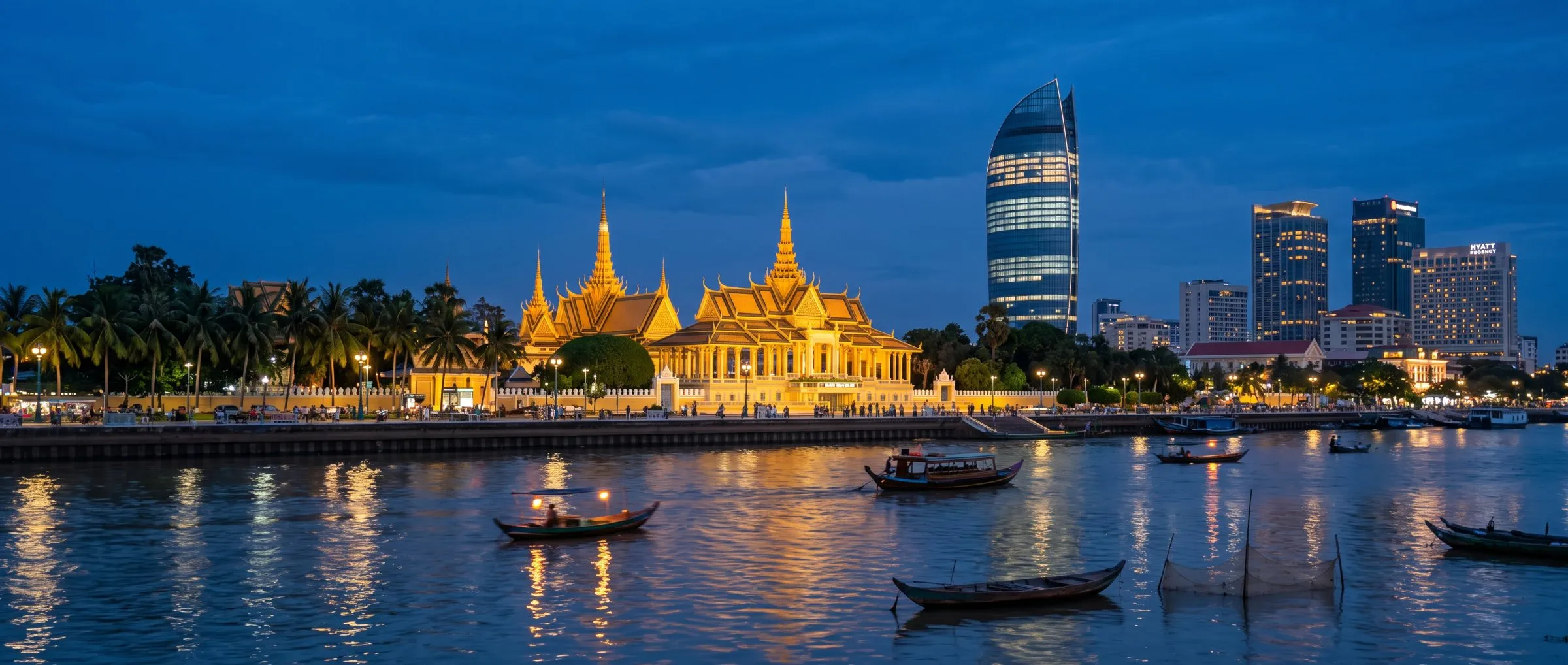
Phnom Penh
Registration, tax and incentive processes all run through the capital. So does Whitewater.
Getting registered
Company formation, step by step
- 01 Name reservation Reserve the company name with the Ministry of Commerce
- 02 CamDX registration Register through the online Single Portal, typically 8 to 10 working days
- 03 Tax registration General Department of Taxation registration
- 04 Bank account and capital Open the corporate account with an authorised bank
- 05 Labour declaration Declaration of opening with the Ministry of Labour
- 06 Sector licensing Sector-specific licences where applicable; allow additional time
- 07 QIP application CDC application where incentives are sought; certificate within 20 working days
Available vehicles include the private limited company, which may be formed with a single shareholder, the branch office, and the representative office. Two to three weeks is a prudent end-to-end allowance for standard registration before sector licensing.
Sources: Acclime Cambodia; US State Department 2025 ICS; 2021 Law on Investment
Structuring a Cambodian entry?
An exploratory consultation maps your project against the QIP categories, ownership structures and registration path that fit it.