Infrastructure
The logistics reality, measured
Export economics depend on infrastructure, and Cambodia's is expanding fast from a low base. This page reports what exists, what is committed, and where the gaps are. Facility siting and route design work around all three.
Sea freight
Ports
Sihanoukville Autonomous Port
Cambodia's only deep-sea international port surpassed one million TEUs of annual throughput in 2025 and is executing a JICA-supported three-phase expansion intended to raise capacity to approximately 2.5 to 2.6 million TEUs by 2029–2030. Container, breakbulk, reefer and warehousing infrastructure with inland logistics connections.
Sources: PAS; Port Technology; Phnom Penh Post
Phnom Penh Autonomous Port
The capital's river port connects to international maritime routes via Vietnam's seaports. Its LM17 container terminal has an annual handling capacity of approximately 500,000 TEUs and handled just over 480,000 TEUs in 2024, with modern quay cranes and automated yard management.
Sources: PPAP; Phnom Penh Post, Jan 2025
Air freight
Airports
Cambodia's air cargo picture changed materially in 2025.
Techo International Airport, Phnom Penh
Since September 2025, Phnom Penh's air traffic has been handled at the new Techo International Airport in Kandal province. Phase 1 is designed for approximately 175,000 tonnes of freight annually, a substantial upgrade on the former Pochentong facility, with capacity phases planned through 2050.
Sources: VINCI Airports; Airport Technology
Siem Reap-Angkor International Airport
Opened October 2023 at a cost of US$1.1 billion, with first-phase capacity of seven million passengers per year and cargo facilities serving the northwest, including the Tonle Sap rice belt.
Sources: Aviation Week; VINCI Airports
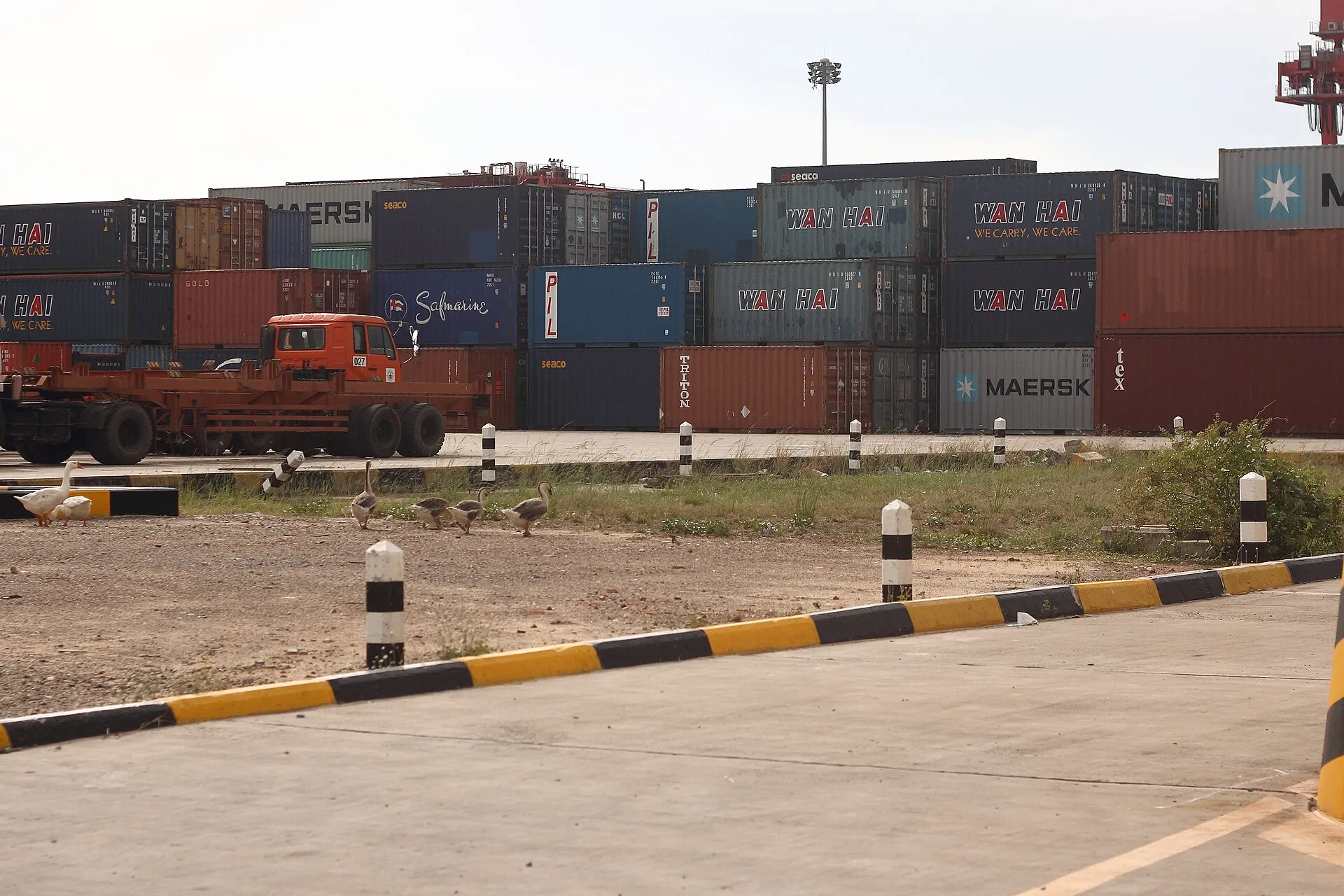
Sihanoukville Autonomous Port
Past one million TEUs in 2025, expanding toward 2.5 million by the end of the decade.
Overland and storage
Roads, cold chain and zones
~17%
Share of rural roads paved; the MRD targets 75% asphalt or concrete by 2030
World Bank; MRD, 2024
140,000 m³
Estimated additional cold storage capacity Cambodia needs by 2030
InfraCo Asia
57
Approved special economic zones, roughly 30 operational across nine provinces
US State Dept ICS 2025
The road network comprises roughly 20,000 km of national and provincial roads and close to 48,000 km of rural roads. Rural road quality is the binding constraint for perishable goods, and it is improving on a published government timetable.
Cold chain is the clearest gap and the clearest opportunity. The country's first port-linked, publicly accessible cold storage facility opened in Phnom Penh in January 2024. For perishable and health-product supply chains, cold chain capacity is a design decision inside the entry plan, not an assumption: siting, owned versus shared capacity, and route timing are engineered around what exists.
Special economic zones add streamlined import and export processes and customs incentives for QIP-registered businesses, with SEZ exports surpassing US$5 billion in 2024. Agro-industrial parks designated in Kampong Thom, Battambang and Kampong Speu provinces mark the government's intended geography for processing investment; a 300-hectare park in Kampong Thom entered feasibility study in January 2026.
Route and siting analysis for your product
An exploratory consultation covers port and air routes, cold chain requirements and zone selection for your category.